

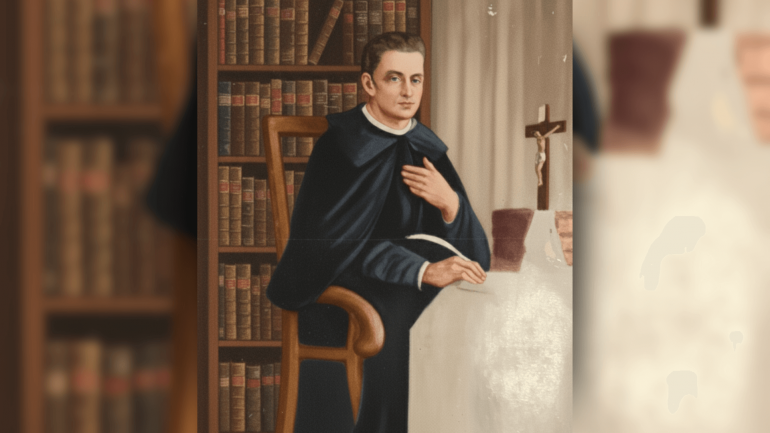
(On the Occasion of his 350th Birth Anniversary)
Biographical Sketch
Jacome Goncalvez, native of Divar (Piedade), was the eldest child of Thomas Goncalvez and Mariana de Abreu. He was born in Chorão at his maternal house on June 8th, 1676. After his elementary studies at Divar, he pursued Latin and Humanities in the Jesuit run St. Paul’s College, and then completed his theological courses at the Dominican Academy of St. Thomas Acquinas, Old Goa. He decided to join the Oratorian Congregation, the first indigenous Congregation in the whole of Asia, and received presbyterial ordination from Archbishop Agostinho de Anunciação at Sé Cathedral on November 15th, 1700. Subsequently, he was granted the post of professor of Philosophy in St. Paul’s College. He relinquished it in 1705 to join the evangelical enterprise with Fr. Jose Vaz in Ceylon.
Call of Ceylon
Ceylon was evangelized under the Persian Christians from first century. It was strengthened with the arrival of Portuguese, in 1505, but faced extinction when Dutch conquered Ceylon in 1658. The latter introduced Calvinism and banned Catholicism and expelled priests. During this period, in Goa, an Oratory of St. Philip Neri was established (September 25th, 1685) under the leadership of Fr. Jose Vaz, but within a year he left for Ceylon, disguised as a coolie, to revive Catholicism. Sometime later, few more Oratorian missionary priests – Joseph de Menezes, Pedro Ferrao, Pedro Saldanha, and Francisco de Jesu – joined him in ministering, leading to a new phase of re-evangelization under the Oratorians.
The urgent need of more priests, led the second group of Oratorians, to join the holy mission. And so, on May 9th, 1705, Fr. Jacome Goncalvez gave up his teaching post to go to Ceylon along with three other Oratorian companions – Joseph de Jesu Maria, Manoel de Miranda, and Miguel de Mello. They reached Talaimannar, North-West of Ceylon, on August 31st and the entire mission was then divided among the existing eight priests. Fr. Jacome Goncalvez received the island of Mannar and some more areas. However, he started his mission first in Jaffna with Fr. Joseph de Menezes before going to his district to get acquainted with the missionary work. When Fr. Jose Vaz took ill, Fr. Jacome Goncalvez willingly took his missions at Kandy, Negombo, Colombo, and Galle. These were dangerous mission areas due to the presence of Dutch. Yet, Fr. Jacome Goncalvez and others, burning with zeal for souls, braved the perils of persecution.
The life of these missionaries itself was a great source of inspiration for locals. They saw in the missionaries that they had given up their comforts of their brahmin homes to be one with them during the persecutory period. Also, cemented their oneness by embracing their local culture and customs, and gaining proficiency in vernacular language.
Re-evangelization and Receptivity
In the Kandyan kingdom, the missionaries were able to evangelize publicly but in the Dutch territories it was perilous. Dutch had issued rigorous edicts against Catholics forbidding all catholic religious activities. This did not deter Fr. Jacome Goncalves and his companions. Though they were very few, they were zealous missionaries. The mission work was not easy. Fr. Jacome Goncalvez and other missionaries had to celebrate Mass secretly, move around in disguised manner, make nocturnal visits to catholic homes and retire in the jungle at daytime to avoid arrest, and traverse long distances through thick jungles against dangers of wildlife.
Through hard missionary labours, Fr. Jacome Goncalvez baptized many to Christianity through doctrinal instructions. As the priest could not be present at the same place for a long duration, he established confraternities, so they could aid in evangelizing mission and gather people of Sundays. Similarly, he would settle some Christian families in Dutch areas to re-evangelize and build Christian community. He built churches and chapels to gather people together for communal prayers and receive sacraments. He won people of other faiths through debates and discussions on the religious themes. He was also a wonder worker in healing and warding evil. He incorporated indigenous socio-cultural practices for evangelization such as processions, dramas, and music.
In the times, where Christianity is portrayed as forceful, the example of Fr. Jacome Goncalvez, how the non-Christian authorities esteemed Christianity and rewarded Christian priests. The King of Kandy Narendrasinha granted Fr. Jacome Goncalvez a place near his palace to build a chapel and a residence, and provided wax candles for services, and even sent his physicians to treat Fr. Jacome Goncalvez when he was sick. Another King, Sri Vijaya Rajasimha, presented an ivory statue of Mary and Jesus to Fr. Jacome Goncalvez. Narendrasinha and his successor, Kumar Astana, were admirers of Fr. Jacome Goncalvez, and because of him permitted Christians to move freely and build churches. They protected these priests against Dutch power. They took great interest and pleasure in reading the literature composed by Fr. Jacome Goncalvez.
Fr. Joseph the Menezes, the successor of Fr. Jose Vaz, chose Fr. Jacome Gonsalvez to represent the mission before the King of Kandy, and made him Vicar da Vara. At this juncture whole island was divided into two division – North was under the authority of Fr. Joseph de Menezes and South under Fr. Jacome Goncalvez. Later, upon the death of the former, in 1724, Fr. Jacome Goncalvez was chosen to be the Superior of the entire mission and Vicar General, but he resigned with humility and allowed senior priest, Fr. Pedro de Saldanha to be the Superior. He became once again the Superior of Oratorian Congregation in Ceylon after the death of Fr. Pedro de Saldanha and Vicar General of Ceylon under the Bishop of Cochin in 1730. Fr. Jacome Goncalvez and the Oratorian missionaries remained faithful to the evangelization and the authority of the Holy See.
Apostolate Through Literature
To root the faith in the local culture, like Matteo Ricci (China) and Robert de Nobili (India), Fr. Jose Vaz had requested Fr. Jacome Goncalvez to devote himself to the study of vernacular language and culture, and produce doctrinal and devotional literature. Fr. Jacome Goncalvez was fluent in Konkani, Portuguese, Spanish, and Latin, and while in Ceylon, he learned Sinhala, Tamil and Dutch. This expertise allowed him to compose large literature for the Christians, producing 42 literary works of varied nature, and earned the title “Father of Catholic Literature in Sinhalese”, and it said, the literature he composed is unparallel and par excellence.
Fr. Jacome Goncalvez translated catholic doctrine and published new catholic literature on Christian themes. Similar to Thomas Stephens’ Khristapurana, he composed Deva Vedha Puranaya, a summary of Bible into Singala. Some of his other works are Dharmodyanaya, a book on biographies of Saints; Prathiharyawaliya, a book on the miracles of Jesus; Sukurtha Darpanaya, a book on the value of Christian life and faith; Kristiyani Palliya, a book on daily prayers. Besides, he wrote polemical works and held public discussion with Calvinists and non-Christians, refuting their errors with such eloquence and erudition, that he was known as the “hammer of the heretics”, and thus, wining Singhalese school masters, Brahmins, Buddhists, and Calvinists. To aid missionaries, he had also composed treaties on moral theology and dictionaries in learning the vernacular languages.
Fr. Jacome Goncalvez was a gifted musician. He composed hymns, carols, and chanting prayers. He introduced passion plays, known as pâsku (from the Portuguese pãscoa), to make a visual representation of the passion moments of Christ. He wrote lamentation chants similar to Goan motets, called pasan (from the Portuguese word paixao). The Dukprâpti Prasangaya written by Fr. Jacome Goncalvez is more popular. These are nine sermons (similar to themes of Goan Santos Passos) in the form of chants to be used during Lent, passion plays, and pasan. Fr. Jacome Goncalvez is also a pioneer of the dramatic tradition of nadagama in Sri Lanka. It is a dramatic entertainment inspired by the Southern Indian street play (terukuttu), and performed to convey religious themes through song and dance.
After thirty-seven years of indefatigable ministry, Fr. Jacome Goncalvez evangelical mission with life and letters came to an end. He died at the age of sixty-six on July 17th, 1742. His remains lie buried in the Church of Our Lady of Assumption, Bolawatta, Sri Lanka.
“Filii tui, India, Administri Tibi Salutis”
I am reminded of the words of the first secretary of the Propaganda Fide, Francesco Ingoli, who in his report had said that the indigenous clergy are better suited to evangelize the east rather than Europeans due to their advantage in knowing the local language, traditions, and can blend well with other local populace in times of persecution due to their colour of skin. If Fr. Jacome Goncalvez and his companions had success in Ceylon, it was precisely because of advantages mentioned by Francesco Ingoli. Besides, they were able to efface the assertions of inferiority, in terms of low motivation and morals and intellectual capacity, levelled the indigenous clergy by the Europeans. The Congregation of Oratorians proved zealous missionaries and produced intellectuals like Fr. Jacome Gonsalvez, whose literary works remains of great calibre.
The Oratorian Mission in Ceylon resown the seeds of Gospel, that culminated with the establishment of Papal Seminary in Ceylon, for the indigenous of Ceylon, India, and Burma in 1890. And on this occasion, Pope Leo XIII said, “Filii tui India, administri tibi salutis" – Your own sons, O India, will be the heralds of your salvation". And these words have proved prophetic then and now.
I conclude with the words of the noted historian, Simon G. Perera, whose scholarship aided in writing this article, “Father Vaz planted and Father Goncalvez watered the vineyard of Ceylon and God gave it increase."