

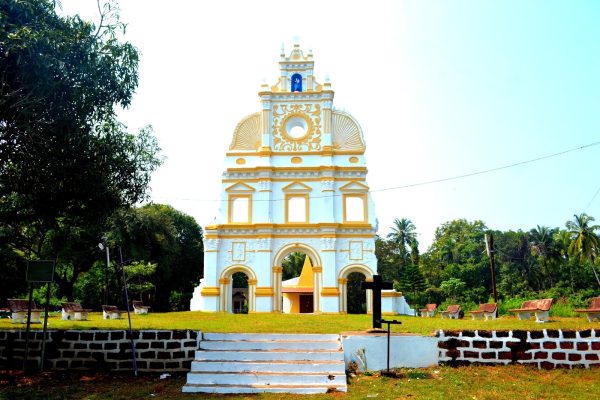
Once again, a rightwing group has raised its voice aimed at distorting history, destroying social fabric, polarizing and advancing communal agenda in Sancoale, during the preparation of the novena and feast of St. Joseph Vaz, a son of the soil. False claims and fallacious narratives are maliciously disseminated as true by the group for divisive propaganda and hate-religion-politics. By twisting truth, they have unleashed violence against history and heritage, of Goa. Hence, the falsity of their ‘facts’ needs to be challenged and countered.
The group claims that the ruins of the original Sancoale Church are ruins of a Hindu temple. This erroneous claim stems from false impression created by rightwing men that all Churches in Goa are built on the sites of former temples pulled down by the Portuguese. One need to understand that in Goa there were indigenous cults and sects, with smaller shrines and separate identity. Their unification was achieved to a certain extent with a political motive in 19th century.[i] Today, the fundamentalists, with their narrow-minded approach, term them as sacred sites of former “Hindu temples” and create communal discord.
Historian Romilla Thapar states there were a variety of communities determined by location, occupation and caste and without any sense of religious oneness.[ii] This pluralism was equally advocated by another historian, D.N. Jha. Researcher and architectural historian, Amita Kanekar, points out that many of present day brahmanical shrines in Goa themselves stand on the sites of these indigenous shrines and those belonging to the Buddhists and Jains.[iii] Similarly, historical sources show that Portuguese destroyed not just Hindu but also Muslim sacred sites.[iv] The act of demolition and building Church was also done by the locals themselves. One such example is that of a temple at Daugim.[v] Hence, neither we should see the destruction of sacred spaces as novelty of Portuguese, as these practices existed even before the arrival of Europeans in India, nor should we look the past with the present mindset or morality. The intentions and complexities involved in demolition will never be known objectively.
Architectural historian Paulo Varela Gomes in his scholarly work on Goan Church architecture shows how the sites for Churches were not always the precincts of ‘temples’ but neutral spaces consciously chosen. The European priests, conscious of the human habitation based on caste and profession, chose spaces which were not identified with any particular existing social or professional group. Spectacular landscapes where chosen, such as facing the rising or setting sun, before an open expanse, paddy field, hilltop and riverbank, so that with its white façade, the Church should be visible from a great distance, like a beacon of faith.[vi] It is in this context that the original Church of Sancoale is to be understood, standing on the riverbank of the Zuari.
The blatant lie that the façade is altered to look like a façade of the Church falls flat before several historical sources of 17th century that attest its authenticity. As affirmed by these sources, the genesis of the original Sancoale Church can be traced to the 17th century. The village of Sancoale comprised of the locals and the Portuguese officials and merchants who had settled in this village along the coast who had to go to Cortalim Church for their spiritual acts. To cut short the distance as well as the difficulty of crossing the tributary of river Zuari, the Christians thought of erecting their own Church. Under the proficiency of Jesuits, the ganvkars (village administrators) built the Church in 1606, which was placed under the invocation of Our Lady of Health (Nossa Senhora de Saúde). This explains why the ganvkars were awarded a place, in the Church, for burial following the tradition of the time. In this Church there are two tombstones belonging to the ganvkars and fidalgos, namely of Cunha, Menezes and Cardoso.[vii] Jesuit historian of 17th century, Sebastião Gonsalves, further provides us details of its interiors. He says the Church was vaulted with paintings on the mysteries of the life of Jesus and Mother Mary; on the altar there was an oil painting and statue of Virgin Mary; the side altars were dedicated to Jesus and St. Braz.[viii] There was also an altar dedicated to Our Lady of Conception which was declared privileged by decree of 19th April 1788.[ix]
Today, the Church lies in ruins. The causes of it were many, the greatest being the lightning that struck and destroyed the edifice leaving only the façade intact.[x],[xi] That very year, the Portuguese Government had suppressed religious orders in Goa, which must have further worsened the situation. Migration was another cause that had its toll on the village. Sancoal witnessed several plagues (could this be the reason why the patron chosen for the Sancoale Church was Our Lady of Health?) which forced the locals to migrate to other parts of Goa.[xii] Many of them relocated in the villages of Loutulim, Margão, Benaulim, Varca to name few.[xiii] One such family that relocated to escape the bubonic plague was the Gaud Saraswat Brahmin Podiar family. One branch settled in Shiroda and the other in Loutulim who got converted and took the surname Figueiredo.[xiv] Therefore, to allege that villagers of Sancoal migrated solely because of ‘forced’ conversion is ahistorical.
Plans for new Church of Sancoal were made during the Archbishopric of Dom Jose Maria da Silva Torres. In 1839 a Chapel having a similar invocation in the same village, at Anaulim, was elevated to the rank of parish and continues to be the Church of Sancoale, till this day.[xv] The original Church of Sancoale, reduced to ruins, remains in that very precarious condition. However, the site and structure of the original Church remained unchanged, in the possession of the present Church of Sancoale. The ‘Fabrica of Church of Sancoale’ continues to be lawfully and peacefully the owner of the said property for more than four centuries with legal proprietorship on Form I and XIV. Therefore, this frontispiece declared as ‘Protected Monument’ by the Directorate of Archives and Archaeology, Government of Goa, mentions the ownership status as ‘Private’ belonging to the Church of Sancoale.[xvi]
The authenticity of the Church similarly can be corroborated with the historical events that are linked to this original Church. It was in this Church that St. Joseph Vaz wrote “Deed of Bondage” on 5th August, 1677 dedicating his life to Mother Mary.[xvii] It is from this incident that the road leading to the ruins of the original Church gets its name as “Rua do Escravo de Maria” (Road of Bondage of Mary). On 19th March 1937, the erstwhile Portuguese Government declared the façade of the Church as a national monument.[xviii] In the year 1951, on the 300th birth anniversary of St. Joseph Vaz a commemorative postal stamp was released with an image of the façade and details stating “frontespicio em ruinas da igreja de Sancoale” that also serves as another historical evidence.[xix] Some of the sacred objects of this Church today are found in other Churches of Goa such as the statue of Our Lady of Health in Mandur, another statue of Our Lady of Immaculate Conception at Neura and Holy Cross in Varca.[xx]
Architectural features such as Corinthian pillars, finials, oculus, Alette, motifs of Holy Spirit, Jesuit monogram, cherubs, dove, reliefs of St. Peter and St. Paul, cross, etc. further validates that the remains are of the Church and not an altered structure of the temple as wrongly claimed by few. Such architectural features neither match nor form part of Goan temples.
In fact the right-wing group is manipulating the ruins by misuse of history. The group is trying to buttress its arguments by imposing false charges of forceful conversions by missionaries, murder through Goa Inquisition and mutilation at Hatkatro, which are either exaggerated or misleading. Historical details by scholars such as Anthony D’Costa, Henry Heras, Rowena Robinson, Delio Mendonça, have shown that conversion was not always the case of coercion but happened out of conviction and choice too.[xxi] Often social ostracization from one’s own caste led the locals to embrace Christianity willingly who found it more welcoming and liberating. Further, thousands of Hindus put to death by Goa Inquisition tribunal is an over exaggerated fact. Figures of auto da fe (act of faith) by which the guilty were punished by burning at stake do not cross more than two hundred. In fact, the aim of the inquisition was primarily chastisement of New Christians (novos cristãos), Jewsin particular, who had converted to Christianity but secretly resorted to their old religious practices.[xxii] There are scholars who have studied the Goa Inquisition such as James Boyajian, Célia Tavares, Miguel Lourenço, José Tavim, Giuseppe Marcocci, Jose Pedro Paiva among others whose research do not match the false narratives of rightwing groups. The nomenclature “Hatkatro” does not exist in Portuguese records. Portuguese sources refer this pillar as “Pelourinho Novo” (new pillory). That the limbs of Hindus were severed at this pillar is simply untrue. Portuguese did not follow sharia law and no records state that mutilations were held. It is a myth that has been created by rightwing groups.
Today, the Goans and in particular the Goa Government under “The Goa, Daman and Diu Ancient Monuments and Archaeological Sites and Remains Act, 1978” has utmost duty of protecting this monument from misuse and desecration. This Act, under section 15, states that the place of worship should not be used for any purpose inconsistent with its nature. For Catholics, this site is sacred and of religious use, where spiritual activities are regularly held for many years. Therefore, the puja (Hindu religious ceremony) that was held on 30th December 2020 was a gross violation of this Act as well as the abuse of the welcome given by the Christian community. Regrettably, the offensive act of 30th December 2020 saw in January 2022, a repeat demonstration, this time with chanting of slogans “Jai Shree Ram” and creating communal animosity. This have further contravened Section 153A of IPC, which forbids promoting enmity between religious communities, and Section 295A which states that deliberate and malicious acts, aimed to outrage religious feelings, are punishable.
The sacred site of old Sancoale Church always known to have welcomed people of all faiths, following in the footsteps of Jesus, and of St. Joseph Vaz, who served people of all religions with love and tenderness, sad that it had to face an insidious act by a rightwing group. May Goan religious harmony and peaceful co-existence prevail over such dark forces.
(This article was first published on Renevocão)
Sources
[i] Victor Ferrão, “The Other Orientalism - The Challenge and Opportunities for the Church in Goa,” accessed on 8th January 2022, available at https://goanet-news.goanet.narkive.com/ubtsmPjE/goanet-reader-the-other-orientalism-the-challenge-and-opportunities-for-the-church-in-goa-victor.
[ii] “Imagined Religious Communities? Ancient History and the Modern Search for a Hindu Identity by Romila Thapar - A Summary,” accessed on 8th January 2022, available at https://cluelesspoliticalscientist.wordpress.com/tag/romila-thapar/.
[iii] Amita Kanekar, “How Ancient are Ancient Temples?” accessed on 8th January 2022, available at https://alzulaijgoa.com/2018/11/15/how-ancient-are-ancient-temples/#_ftnref3.
[iv] Timothy D. Walker, “Contesting Sacred Space in the Estado da India: Asserting Cultural Dominance over Religious Sites in Goa,” accessed on 8th January 2022, available at https://journals.openedition.org/lerhistoria/8618#tocfrom1n2.
[v] António da, Silva Rêgo, Documentação para a história das missões do padroado português do Oriente, vol. 2, (Lisboa: Agência geral do ultramar, Divisão de publicacões e biblioteca, 1947), 343.
[vi] Paulo Varela Gomes, Whitewash, Red Stone – A History of Church Architecture in Goa, (New Delhi: Yoda Press, 2011), 20-21.
[vii] Moreno de Souza, Saxtticheo Igorzo, (Old Goa: Rotti Prokaxon, 2005), 214.
[viii] Sebastião Gonca̧lves, Primeira parte da Historia dos religiosos da Companhia de Jesus, vol.3, ed. Josef Wicki, (Coimbra - Atlântida, 1962),92.
[ix] “Sancoale: A Parish of Rich Religious History,” accessed on 8th January 2022, available at https://www.navhindtimes.in/2016/05/20/magazines/buzz/sancoale-a-parish-of-rich-religious-history/.
[x] Savio Rodrigues, Jesuit Heritage of Goa, (Panjim: Goa Jesuits, 2009), 130.
[xi] Nascimento Mascarenhas, Follow Me – Parish Priests of the Parish of Salcete and Margao, vol. 3, (Saligao: Goa 155), 330.
[xii] Fatima da Silva Gracias, Health and Hygiene in Colonial Goa (1510-1961), (New Delhi: Concept Publishing Company, 1994).
[xiii] Moreno de Souza, Saxtticheo Igorzo, (Old Goa: Rotti Prokaxon, 2005), 216.
[xiv] Prachi Joshi, “Where to go in 2019: Goa’s Treasured Portuguese Charm,” accessed on 8th January 2022, available at https://natgeotraveller.in/where-to-go-in-2019-goas-treasured-portuguese-charms/.
[xv] Francisco Catão, Anuario da Arquidioese de Goa e Damão para 1955, (Bastora: Tipografia Rangel, 1955), 156.
[xvi] “List of Protected Monuments,” accessed on 8th January 2022, available at http://daa.goa.gov.in/en/list-protect-monuments.
[xvii] Sebastião do Rego, “Vida do Venerável Padre José Vaz” (Goa: Imprensa Nacional de Goa, 1962), 172.
[xviii] Nascimento Mascarenhas, Follow Me – Parish Priests of the Parish of Salcete and Margao, vol. 3, (Saligao: Goa 155), 330.
[xix] Accessed on 8th January 2022, available at https://www.philindiastamps.com/products/ portuguese-india-1951-ruins-of-sancoale-church-architecture-sc-508-blk-4-mint.
[xx] Moreno de Souza, Saxtticheo Igorzo, (Old Goa: Rotti Prokaxon, 2005), 215.
[xxi] Rowena Robinson, “Some Neglected Aspects of the Conversion of Goa: A Socio-Historical Perspective”, in Sociological Bulletin, vol. 42, (1993), 65-83.
[xxii] José Pedro Paiva, “The Inquisition Tribunal in Goa: Why and for What Purpose?” in Journal of early modern history 21, no. 6 (2017): 565-593; James Boyajiyan, “Goa Inquisition - A New Light on First Hundred Years (1561-1660),” Purabhilekh-Puratatva 4, no.1 (1986): 1-40.