

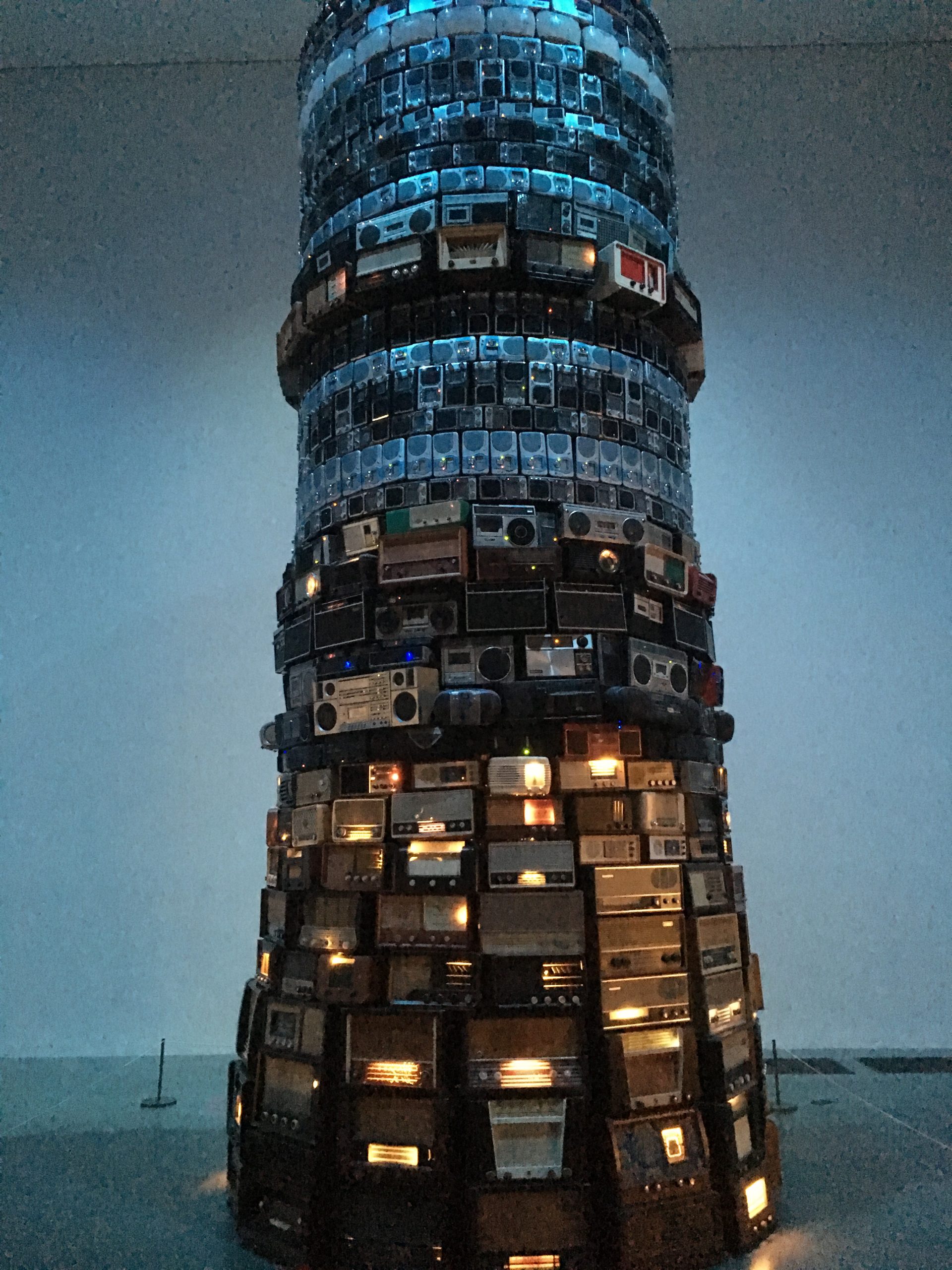
Tate Modern, the renowned modern art gallery situated in London, houses some of the most innovative and challenging works of contemporary art. Among these stands a particularly arresting installation by the Brazilian conceptual artist Cildo Meireles, titled Babel (2001). The work takes the form of a towering, circular structure composed of hundreds of second-hand analogue radios stacked in concentric layers. Each radio is tuned to a different station and adjusted to the lowest audible volume. Yet together they produce a continuous, dense murmur. Voices, music, fragments of speech, and static collide, overlap, and dissolve into one another, creating a soundscape that is at once immersive and disorienting. Information is present in abundance, yet meaning remains inaccessible. Many sounds are heard, but no message is conveyed.
Meireles’s Babel is an unmistakable allusion to the Tower of Babel narrative found in the Book of Genesis (11:1–9). In that ancient story, humanity, united by a single language, sets out to build a tower “with its top in the heavens,” seeking to establish permanence, control, and renown. The project is disrupted when language itself fractures. The unity once sustained by a single tongue collapses into confusion, and the people are scattered across the earth. What had begun as a collective endeavour dissolves into fragmentation. The tower remains unfinished, a monument to ambition interrupted by multiplicity.
The biblical Babel is not merely a story about linguistic diversity; it is a profound reflection on the dangers of human self-sufficiency and the illusion of total comprehension. Language, once a bridge, becomes a barrier. Voices proliferate, but understanding recedes. Meireles’s Babel renders this reality in modern form. Surrounded by countless voices, we are unable to grasp a single coherent word. The tower no longer reaches heaven; instead, it traps us in noise. Amid the clamour, the Word is not heard.
This distinction between voice and Word finds a powerful echo in the writings of St Augustine of Hippo. In one of his sermons, Augustine reflects on the relationship between John the Baptist and Jesus Christ, using the evocative imagery of voice and Word. John, Augustine explains, is the voice; Christ is the Word. The voice exists to announce, to point beyond itself. The Word, however, pre-exists the voice and gives it meaning. The voice passes; the Word endures. “Take away the word,” Augustine notes, “what is the voice?” The voice without the Word is mere sound.
Augustine is careful to highlight the danger of confusing the two. Many, he observes, mistook John for the Messiah because they mistook the voice for the Word it proclaimed. John himself resists this misunderstanding, humbly acknowledging his role: he is not the light, but one who bears witness to the light (John 1:8). Through this distinction, Augustine underscores the primacy of the Word and warns against elevating the messenger, the noise, or the medium above the truth it serves.
This ancient warning feels uncannily contemporary. The threat Augustine identified has not faded; it has multiplied. While analogue radios may now be relics of the past, digital channels have expanded exponentially. Voices surround us constantly: news feeds, notifications, opinions, commentaries, podcasts, and social media streams. We no longer stand outside the tower observing its confusion; we inhabit it. The cacophony is not only ad extra, in the world around us, but also ad intra, within us. Competing desires, anxieties, fears, and aspirations echo relentlessly in our inner lives. This internal scatteredness mirrors the external noise. We struggle to focus, to listen deeply, to discern what truly matters. The abundance of voices does not lead to clarity; rather, it often results in paralysis or exhaustion. Like Meireles’s radios, each voice demands attention, yet none offers lasting meaning. In such a condition, the Word risks being drowned out not by hostility but by sheer excess. And yet, the human heart continues to yearn for clarity and coherence, for a Word that does not change with trends or volume. Beneath the noise lies a longing for something stable, true, and life-giving. It is precisely here that the season of Lent offers a profound invitation.
Lent is not merely a time of external renunciation; it is a season of reorientation. Beginning with the stark reminder of Ash Wednesday, we are invited to confront our fragility, our distractions, and our scatteredness. While many of us may have begun the New Year with resolutions and goals, Lent offers a renewed opportunity to set a deeper, more enduring intention: to listen. This forty-day journey toward Easter is a deliberate slowing down, a turning away from noise and toward the Word.
Silence becomes central to this journey. Not simply the absence of sound, but the cultivation of interior stillness. To silence the voices within us is no easy task. It requires patience, discipline, and honesty. Yet without such silence, the Word cannot be heard. As Elijah discovered on Mount Horeb, God is not always found in the wind, the earthquake, or the fire, but in the “sound of sheer silence” (1 Kings 19:12).
The Scriptures consistently bear witness to the consequences of listening or failing to listen to the Word. Throughout Israel’s history, the prophets issued the same invitation again and again: return, listen, remember. The opening verses of the Psalms capture this call with striking clarity:
“Happy are those who do not follow the advice of the wicked,
or take the path that sinners tread,
or sit in the seat of scoffers;
but their delight is in the law of the Lord,
and on his law they meditate day and night” (Psalm 1:1–2).
Here, happiness is not linked to accumulation or noise, but to meditation, to dwelling attentively with the Word. The tragedies of exile, division, and destruction recounted in Scripture are not arbitrary punishments; they are the natural consequences of forgetting, ignoring, or replacing the Word with other voices.
In a world that increasingly resembles Meireles’s Babel, Lent invites us to step back from the tower. It calls us to distinguish once more between voice and the Word, between noise and meaning. The task is not to eliminate all voices, but to order them rightly, allowing the Word to reclaim its primacy. Amid the multitude of sounds, the Word still speaks. It does not shout. It waits. Lent trains the ear of the heart to hear again, to listen beyond the cacophony, and to discover, in silence, the Word that gives life.
(Published on Renewal, Vol LXIV, No. 4, January 16-28, 2026)