

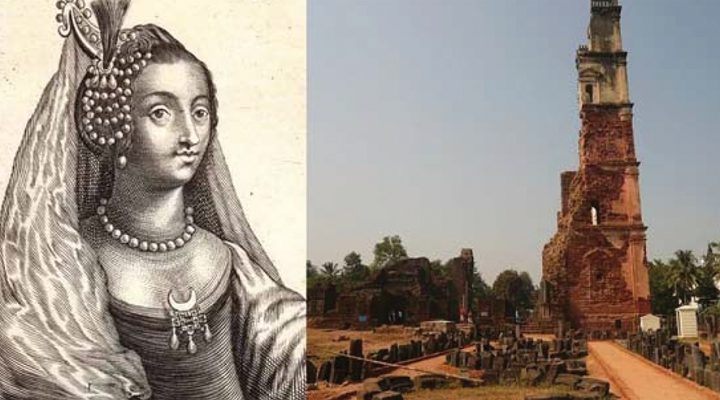
Queen Ketevan, also known as “Ketevan the Martyr” is a saint canonized by the Georgian Orthodox Church in 17th century since she died in odium fidei (in hatred of the faith). But did you know that her relics lied buried for many years in Goa far away from Georgia?
Many were caught by surprise when the international and national media highlighted the event of India’s External Affairs Minister, S. Jaishankar, handing over the relics of the queen to the Georgian government in the hands of Georgian Foreign Minister, David Zalkaliani, during his two-day diplomatic visit to the country on 9th July 2021. The ceremony was held in Sameba Holy Trinity Cathedral, Tbilisi (Georgia) in the presence of political leaders as well as Beatitude Ilia II, Catholicos-Patriarch of All Georgia. During the ceremony the minister S. Jaishankar had special thanks to the people of Goa for ‘guarding’ the relics. Prime Minister Narendra Modi too lauded the efforts in his monthly radio programe Maan ki Baat.
One may wonder why the relics were parted with Georgia when the relics ‘belonged’ to Goa. Well, a brief glance over the history will unfold this saga. Ketevan (1560-1624) was born in a royal family to Prince Ashotan I and married to King David I of Kakheti kingdom, a hilly region in the eastern Georgia. She was regent to her son Teimuraz I since the reign of King David I short-lived. In 1613, Shah Abbas I, the Emperor of Persia, invaded and took Queen Ketevan as prisoner. After a decade, the emperor forced her to forgo Christianity and convert to Islamic faith and join his harem. Refusal to give up Christianity led to her merciless death at the hands of the Safavid suzerain in the city of Shiraz (in modern day Iran) on 22nd September 1624. In the preceding year, there were two Augustinian friars who had arrived in Shiraz to evangelize who were her confessors and who had witnessed her public execution and burial. They exhumed the remains and hid them for almost two years. In 1627, they brought some of the remains of her right arm to Goa and remaining portion was interred at the Alaverdi Monastery in Georgia. It is said that due to invasion when the relics were to be transferred to another safe place they were lost when the carrier fell in river.
The Georgian people were not aware of the sacred remains of Ketevan in Goa. The excitement came about when historian Roberto Gulbenkian authored a book in 1985, collating medieval Portuguese records, and stating that the queen’s relics were kept in a black box (stone sarcophagus) on the second window along the Epistle side of the chapter chapel in St. Augustine convent, Old Goa. In 1989, Georgian delegation visited Goa in order to find the long ‘lost’ queen in collaboration with Indian Ministry of Home Affairs and Archaeological Survey of India (ASI). Excavations ensued without any result. Despite knowing the exact location based on the literary sources, in reality it was a difficult task, firstly to interpret the location, and secondly the convent was in ruins with heaps of debris of the collapsed structure. After several attempts to interpret the location the ASI was able to locate the “chapter chapel and window” as mentioned in the sources, in May 2004. In 2005, three bones were found eight to ten meters deep. But the result remained inconclusive as to which one belonged to the queen, as the sources mentioned that the queen’s relics were kept along with the relics of another two friars. In November 2006, bones were taken to CSIR-Centre for Cellular and Molecular Biology, Hyderabad for further analysis. In 2013, the remains were confirmed through DNA analysis by a team of molecular biologists that one of the bones was of Georgian descent. Additional tests confirmed that the bone is of a woman. This brought the series of searches to fruition that the sacred remains were indeed of Queen Ketevan of Georgia. The hunt was a combined effort of the multi-disciplinary team. Ever since the find the relics were in possession of ASI.
In 2017, at the request of the Georgian government the relics were temporarily sent to Georgia for a period of six months, to commemorate twenty-five years of diplomatic relationship between the two countries. The loan was extended for another six month and the holy relics reached back to India on 30th September 2018. However, there was a persistent request from Georgia for a permanent transfer due to the strong spiritual sentiments attached to the Georgian queen St. Ketevan. Hence, in 2021 Indian government decided to gift one portion of the relics to Georgia.
As reported by a local daily, it would have been a good initiative if the locals too were taken into consideration and more so, if the ceremony was held in Goa. Yet, it is a good gesture from the Indian Government and ASI to offer a portion of the relics. This return of the relics, nearly four hundred years after queen’s death and nearly sixteen years after the discovery, will now deepen ever more the relation between Goa and Georgia. While the legacy of the Queen Ketevan will continue here with the remaining portion of the relic, so also with the “Ketevan World Sacred Music Festival” that is annually held in Old Goa and the Queen Ketevan diorama that has been set up in the ASI Museum, Old Goa. May long live the queen!
(This article was first published on Renevocão)