

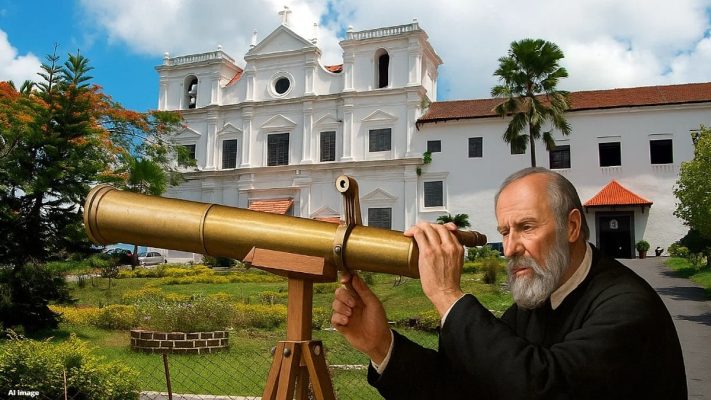
Use of Telescope in Goa
The men of cloth being men of science would carry not just Gospel but also European science. In a similar fashion, a Jesuit priest from Kadan, Wenceslaus Pantaleon Kirwitzer (ca. 1589-1626), a member of the Collegium Romanum, was in Goa while on his sojourn to China. Kirwitzer who was part of mission destined for China was one among the group of 22 missionaries had set on sail from Lisbon on April 1618 led by Nicolas Trigault (1577-1628) which included some priest-astronomers Giacomo Rho (1592-1638), Johannes Schreck-Terrentius (also Terrenz; 1576-1630) and Adam Schall von Bell (1592-1666). They had carried with them few telescopes, some measuring instruments, and a large number of books.
They entered Goa on 4 October 1618. While this halt was made, two great comets appeared in the morning skies of November in quick succession. Since this would require joint efforts and astronomical instruments, Kirwitzer wrote to his fellow Jesuits: Fr. Jacobus Rho at Goa and Fr. Antonius Rubinus at Cochin.
Hence, in Goa, the observations were done at Collegio Rachol, Insula Ivari (Divar) and at St. Paul College (Old Goa). Kirwitzer mentions that he made the use of telescope to observe the comets but the type of telescope used is not known whether Galilean telescope with a mount or hand-held with draw out-tubes. These Jesuits also made the use of other astronomical instruments namely astrolabe and astronomical radius, i.e., cross-staff.
The first comet was observed from 10th to 30th November. However, on certain days it was not possible due to the cloudy sky. Kirwitzer made the observation from Divar and Old Goa while Fr. Jacobus Rho observed it from Rachol and Old Goa. The second comet was seen on 24th November. On the same day it was observed by Fr. Johannes Terrentius from the fields of Rachol College. This particular comet was observed till 12th January 1619.
What did the observers saw and measured? Namely, the altitudes and azimuths, angular distance from stars like Spica etc. in grad (degrees), and the observers' visual impressions, including difficulty from illumination due to the moon and sunlight. Later, these observations were collated and published in a monograph titled Observationes Cometarvm Anni 1618. In India Orientali Factae a Societatis iesv Mathematicis in Sinese Regnum Nauigamtibus ex Itinere eo Delatis. This was published by Schönwetter in Ursellis, in the year 1620.
These comets were also independently observed by the fourth Mughal Emperor of India Jahangir (1569-1627) with the use of astronomical instruments namely astrolabes, accurate water-driven clocks (clepsydras), sundials and sandglasses.
The significance of this event is twofold: firstly, it was the first modern astronomical observation in India and secondly, the first use of optical device (telescope) for astronomical observation in India, dated November 10th 1618 this makes Goa the birth place of telescopic observation in India and not Surat as was previously believed.
This has put Goa and Rachol Seminary in particular on the world map for its scientific contribution. What is more interesting is that if Fr. Kirwitzer, a Jesuit priest from Europe came and contributed to the Indian astronomy in the past; today we have our very own Goan Jesuit priest Fr. Richard D'Souza working at the Vatican observatory and contributing at a universal level. He had stormed the headlines last year by discovering a long-lost sibling galaxy of the Milky Way.
Rachol Seminary, continues to promote science through various ways such as seminars, publications and has even produced stalwarts in the field of science like Late Fr. Antonio Francisco Souza. Fr. Victor Ferrão, former student and currently a professor in the Rachol Seminary became the first person in India to do his doctorate in the field of science and religion.
Astronomical Principles in Religious Architecture of Goa
As part of broader evangelization mission, Jesuits raised religious architecture. Sarvesh Sinai Borkar, a local archeo-astronomy enthusiast and researcher opines that those Churches that are east-west facing, constructed between 16-17th centuries has made use of astronomical principles in their architecture in various ways. For instance, use of controlled light to illumine certain portions, on specific days of the year, at a particular time. This type of astronomical marvel was witnessed in the Holy Spirit Church, Margão which is a Jesuit construction. A beam of light was shining before sunset on equinox, on the image of Holy Spirit on the main altar and two other side altars.
Some of the Churches even served as practical observatories that based on the rising and setting of the sun aligned on the equinox and solstice day with the western and eastern entrance. Many Churches even had astronomical instruments like sun-dial watches. Such watches are seen in Jesuit built Churches even today such as Lotoulim and Verna. Rachol Seminary which is also a Jesuit architecture has two such sun-dials one painted on the seminary courtyard and another made of stone.
The reasons for incorporating such astronomical principles probably was to show relation of human activities to the cosmos, to maintain time, to determine the day of the equinox and for other religious purpose.
Involvement of Jesuits in India
As we have seen, Jesuits who came to the "mission fields" were trained in practical astronomy and considered India as "theater for their apostolic work". Known for their scientific scholarship, Jesuits soon found favour with the Mughal emperors and local rulers in their courts such as Emperor Akbar (1542-1605) and king-astronomer of Ajmer, Raja Jai Singh II.
By 17th century, telescopes were available in India. Jesuits were involved in exploring the hinterland as they had expertise, time and opportunity, unlike the European traders. Jesuits had to explore local astronomical traditions, document their methods and search sightings of historical astronomical events. Reports of all their activities and observations had to be sent to the Padroado authorities which are known as Annual Reports and Edifying Letters, which became a mine of information for the scientist and academies of sciences.
The missionaries who provided the knowledge of Asian world was benefited by the Europeans in several ways irrespective of the Jesuit intention. The French Jesuits were involved more in astronomical observation than the Portuguese Jesuits due to their intellectual traditions and social orderings. Many were members of the Academia des Sciences.
It is also to be noted that the Jesuits were constrained or could not bring to India all the advanced knowledge of science due to the certain Church ideologies it held on to. Therefore, the knowledge of Copernican heliocentrism was not introduced. It is also said that with the exception of few like Boudier and Tieffenthaler, Jesuits in India were not so great astronomers. Historian of science S.N. Sen states that the contribution of Jesuits in modern astronomy to China is comparatively more than India.
However, Dhruv Raina, is of the opinion that these hypothesis needs revision. He says that though it was on grand scale in China, French Jesuits in India provided impetus and historical inquiry into ancient Indian astronomy. Also the efforts of Jesuits, in China and India, complemented each other. Dhruv, also says that, the critique that Jesuits of India were not the best scientists and were not in contact with the leading scientists of Europe comparatively to Chinese counterparts is an overstatement. The reports of French Jesuit scientist in India became a source material for the French astronomers for three generations.
I would like to highlight some of the contribution of the Jesuit priests. Fr. Anthony Monserrate (1536-1600), was a first Jesuit geographer in India. Based on his astronomical observations, he formed a partial map of India. Fr. Jean-Venant Bouchet (1655-1732) surveyed the peninsula, and his interior map is considered as "the first map of any merit", dated 1722. Fr. Jean Richaud is credited for the first astronomical discovery from India. He discovered in 1689 the bright southern star Alpha Centauri. Fr. Claude Stanislaus Boudier (1686-1757) was a "skilled telescopic observer" determined latitudes and longitudes of around 60 Indian cities. Fr. Joseph Tieffenthaler (1710-1785), carried out astronomical observations in different part of India including Goa. He observed the transit of Mercury in Goa on November 4th, 1743.
Jesuits made important contribution in the field of positional astronomy and cartography. As a result of Jesuits introduction of telescopic astronomy many observatories came up in India, which was later institutionalized by East India Company. It also gave rise to photographic and spectroscopic astronomy attracting European solar physicist. Based on the contribution of Jesuits India has made great progress in the field of astronomy.
Engagement or Estrangement: Importance of Astronomy in Religion
The Church Fathers were against astronomy for the reasons that it does not benefit one's salvation but rather limits God's omnipotence and hence the knowledge should be reserved only to God. However, the Jesuit astronomers proved it to be beneficial as it gives the knowledge of God. Some Jesuit-astronomers like Christopher Clavius says astronomy leads men on path to God.
Giovanni Battista Riccioli states it is a noble science that leads to the habitation of God while Franciscus Levera says it strengths love of God as well as abolishes idolatry. Johannes Kepler concurs with similar thoughts that astronomy gives 'knowledge, admiration and worship of the omniscient God' also, exploring heavens leads man to his original mission that is imago dei. Philosopher Francis Bacon is of the opinion that studying the cosmos is a recovery of power and sovereignty man once possessed in the paradise.
What does the contribution of the Jesuits missionaries in astronomy suggests? That faith and science can harmoniously exist together and both can enrich each other in the understanding of God and cosmos. It is often portrayed that there is a warfare between religion and science.
Infact, modern science is an invention of medieval Christianity. In his speech in Regensburg, Germany on September 12, 2006, Pope Benedict XVI said that it was due to Christianity's emphasis on the importance of reason that science developed in Europe, in the civilization then called as Christendom.
Many of the scientist were clergymen like Georges Lemaitre, a priest-astronomer from Belgium who first proposed the "Big Bang Theory" for the origin of universe and Gregor Mendel an Augustinian monk who is considered as "father of modern genetics". Similarly many of the towering figures of science such as Nicolaus Copernicus, Galileo Galilei, Johannes Kepler, Tycho Brahe and others were Christians.
Scholar Dinesh D'Souza in his work What's So Great About Christianity poses for us a question "where would modern science be without these men?
Church still engages and promotes science, hence we have 'Pontifical Academy of Sciences' and 'Vatican Observatory' at Holy See established to promote true science. Therefore, what biologist Joshua Lederberg said is true "what is incontrovertible is that a religious impulse guides our motive in sustaining scientific inquiry."
Conclusion
Rachol Seminary has a distinct place for its contribution in the field of astronomy and an institution that has fostered scientific culture. It will be remembered in history as an institution that has endured exchange between Europe and India, the East and West. One cannot undermine the contribution of Jesuits in Goa and beyond who gave rise to the beginning of modern science in India.
These men of cloth were not just proclaimers of the 'book of scripture' but unraveled the 'book of nature' too so that God may be known and glorified. Church, which considers 'evangelization as its identity' does not shun away from this scientific culture but continues to make best use of it for evangelization. Science therefore is not just for scientists but for all of us to make use of, to know more about God and to proclaim His wonders by studying the colossal cosmos.
(This article was published online on Indian Catholic Matters, February 7th-8th 2024)