

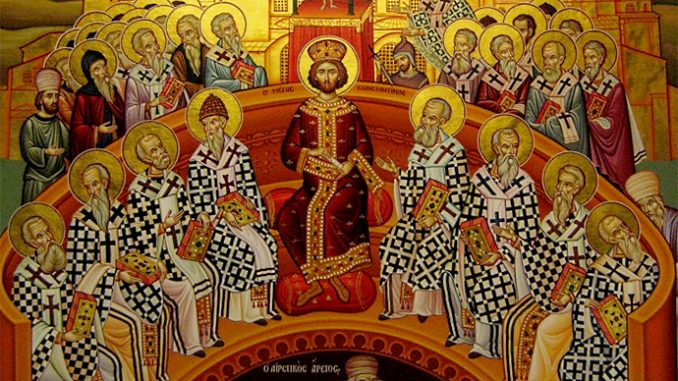
On 28th November Pope Leo XIV along with the ecumenical patriarch of Constantinople Bartholomew I and representatives of different Churches, gathered in the city of Iznik (ancient Nicaea), Turkey, to commemorate the 1700th anniversary of the First Ecumenical Council held in 325 A.D. at Nicaea. This also marked the first Apostolic Journey of Pope Leo XIV’s pontificate.
The First Ecumenical Council was summoned to address the theological quarrel that had arisen about Christ’s relation with the God the Father. Presbyter Arius taught that Christ was a created being, or begotten, by the God the Father, and therefore, not of the same substance but subordinate to the Father. His principal opponent, Bishop Alexander of Alexandria’s position was that the Son is divine and eternally generated from the Father. Both sides had gathered significant followers and the dissension threatened to tear apart both the Church and empire. This conflict caused the Emperor Constantine I, who had decriminalised Christianity with the Edict of Milan in 313, to find a way to settle the dispute. The Council was convoked at Nicaea in May or June of 325 and concluded in the first weeks of July 325. As per tradition, 318 bishops participated, thus making it first ecumenical council, attended by bishops from both the East and the West. Significantly, 318 was also the number of servants that the Patriarch Abraham used to save his nephew Lot from captivity (Gen.14:14). Similarly, the Emperor Constantine I, who had liberated Christians from persecution by passing the Edict of Milan, now gathered 318 Council Fathers, to liberate those who had fallen into the heretical captivity.
The council presided by Bishop Ossius of Cordova on behalf of the Emperor, eventually condemned and anathemized Arius and his followers, and upheld the “Alexandrian position”. Utilising a non-biblical term to resolve the theological issue, the Council affirmed that the Son is “of the same essence” (Greek - homoousios) with the Father. The resulting resolution was the creed which, following revised at the Council of Constantinople in 381, is now known as Nicaean-Constantinople Creed.
Another term - filioque (Latin – “and the Son), to suggestthat the Holy Spirit proceeds from both the Father and the Son was, added by the West to the Nicaean-Constantinople Creed during the Third Council of Toledo in 589. This clause was not added in the Greek version of the Creed by the Eastern Orthodox Church, and became a point of contention between the two churches, eventually contributing to the Great Schism of 1054, which divided the Eastern Orthodox Church from communion with the Catholic Church. Significantly, the filioque was omitted even at the commemoration of the council’s 1700th anniversary, manifesting not irreconcilable differences, but unity beyond uniformity.
The second major decision taken at the Council concerned the date of Easter. The Council Fathers reiterated an earlier decision taken at the Council of Arles in 314, insisting that all Christians must celebrate the Easter on the same date and on Sunday, the day of the Lord. The desire for uniformity was to prevent the scandal of the celebration of Easter on different days. However, despite the call for unanimity disagreements over the dates prevailed because certain churches in the East did not want to give-up their traditions which calculated the date of Easter based on the Jewish calendar. The Eastern Orthodox Church still follows the old Julian Calendar, which the Western Church abandoned by adopting Gregorian Calendar in 1582 due to the inadequacies of the Julian Calendar. Though both the Churches follow the same rule of celebrating Easter on the first Sunday after the first full moon on or after the vernal equinox, their use of their preferred calendars results in a difference of 13 days. Providentially, during this commemorative year of Nicaean Council, a rare alignment of both calendars resulted in a shared date for Easter date. Easter, which is Christ’s “passover” from death to life, symbolises rebirth or renewal, and in the context of common Easter celebration, articulates a call for rebirth and renewal through full communion.
Providentially, God also allowed the rediscovery of the Basilica of Neophytos, believed to been the location of the First Council of Nicaea. This basilica had remained submerged and forgotten for thousand years in the waters of Lake Iznik. It was rediscovered in 2014 when the waters started to recede, and this year it was completely exposed allowing the successors of both the Eastern and Western Churches to come together like the Ancient Church and profess the core beliefs of our common faith, through the recitation of the Nicaean Creed. Just as the Lord parted the Red Sea, through the mediation of Moses the leader of Israel leading them to a promised land, similarly, through our spiritual leaders, God withdrew the waters of Nicaea (Iznik), symbolically, exposing to us a “new path” – of possible full communion.
The commemorative celebration was truly symbolic of communion. Besides the heads of Roman and Constantinople Churches, the other three ancient churches of “pentarchy” were also represented - Antioch, Alexandria and Jerusalem. Even the representatives from the Anglican and Protestant churches participated through their presence and prayers. The prayer service was marked by the chanting of the Kyrie. Kyrie eleison a Greek phrase meaning ‘Lord have mercy’ is commonly found in both Catholic and Orthodox liturgies. Furthermore, the Gospel Reading chosen was Jesus’ prayer of unity. On 29th November, Pope Leo XIV and Ecumenical Patriarch Bartholomew I signed a joint declaration expressing desire for unity as willed by Christ. Not insignificantly, this year is the 60th anniversary of the joint declaration signed by Pope Paul VI and Ecumenical Patriarch Athenagoras on 7th December 1965, which extinguished the exchange of excommunications of 1054. This declaration had opened path for the extermination of division and encouraging dialogue to strive more towards that unity and communion. Hence, the official emblem chosen was a bridge spanning the Dardanelles symbolizing a link of unity between the churches of Asia and Europe.
As this year’s jubilee theme reminds us, hope does not disappoint. Let us, therefore live in hope that the desire of Our Lord that we live in unity will be fulfilled sooner, rather than later.
(This article was first published on Renevocão)